
Origin Story
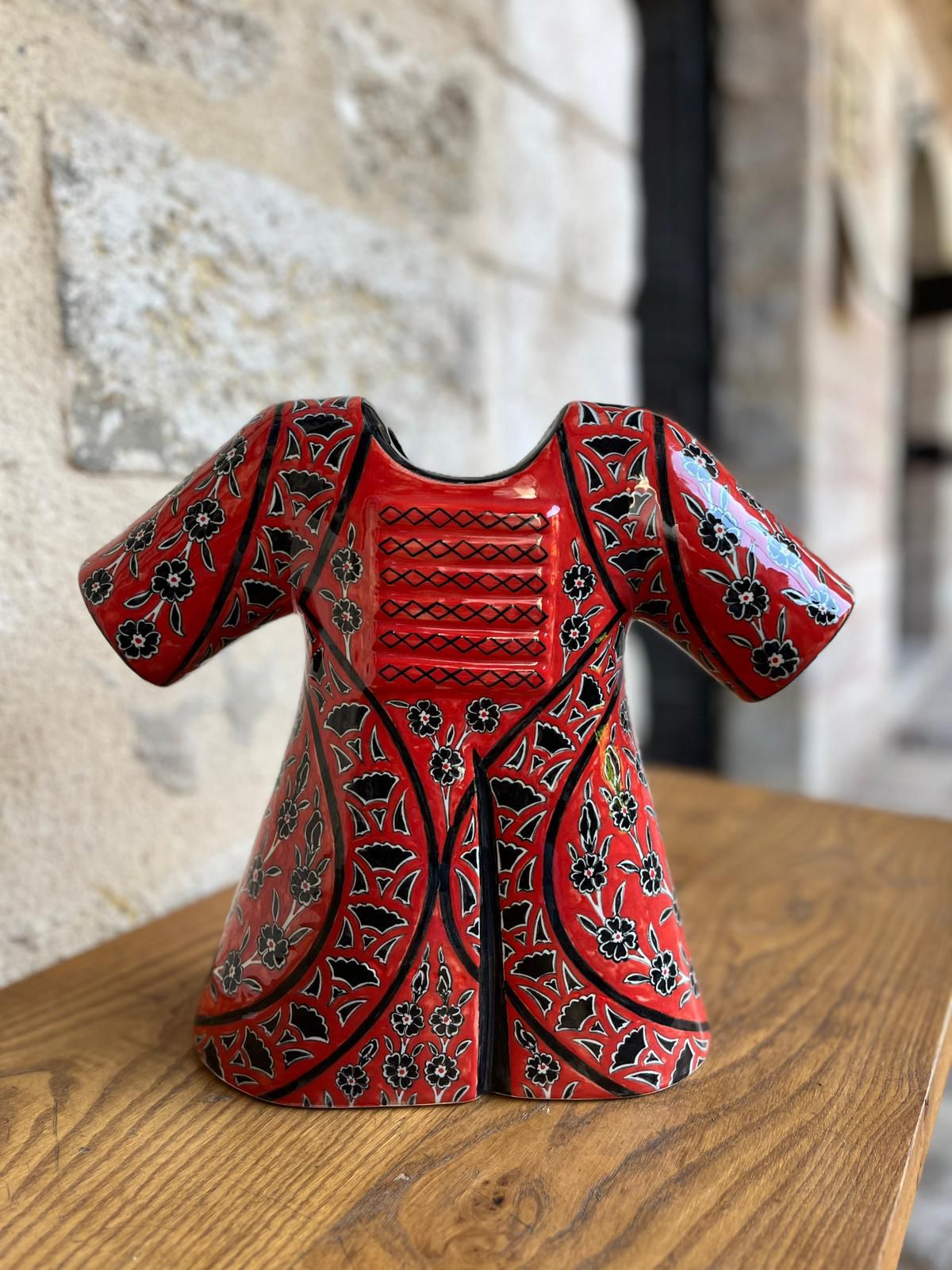
Sultan Ahmed I — builder of the Blue Mosque and patron of some of the finest Iznik tiles ever produced — left behind a small, precise wardrobe, part of which is preserved in the Topkapı Palace collection. Among these garments, one red satin caftan has become an icon: its surface is a quiet field of red, carried by a disciplined pattern in black.
The Meaning of the Pattern
Ottoman court costume was not ornament for its own sake; it was language. The choice of red — a colour of sovereignty and authority — together with the controlled rhythm of the pattern, placed the wearer in a specific register of the Palace's visual protocol. To carry this garment onto ceramic is to carry a vocabulary of power into a different material.
The Çini Project Interpretation
The kaftan has been re-read as a 30 cm standing ceramic form. The silhouette follows the original; the rhythm of the pattern has been adjusted to the curvature of the ceramic body so that the front reads as a single composition. The red ground is achieved inside the under-glaze palette of Iznik, and the black detail has been drawn so the pattern reaches the viewer with the same quiet weight as on the textile.
The piece is an object of display — a desk, a vitrine, a console — where a small portion of the Topkapı collection can be held in the hand.
Signatures
Design adaptation & application: Gül Camadan